Hosted by the University of Melbourne, the ASQ-TRAK Education Program’s core mission is to improve equitable access to culturally appropriate developmental monitoring services and child development support.
The ASQ-TRAK Education Program is a non-commercial endeavour. All revenue derived from educational programs is reinvested to support development and delivery and secure the future of this program. We strive to improve reach and accessibility of the program and welcome innovative community partnership models.
The Program is necessary for users of the ASQ-TRAK Tool, to ensure its faithful use and to promote sustainability. There are different pathways for individuals based on the role they have within their organisation.
ASQ-TRAK Practitioner Education Program is structured and evidence-based that increases the confidence of practitioners to provide culturally safe and effective developmental care for Aboriginal and Torres Strait Islander children and families, using the ASQ-TRAK developmental screening tool.
ASQ-TRAK Practitioner Workshop, the first step of the program, ensures the ASQ-TRAK is used in the way it has been co-designed to be implemented and maintain the cultural safety and quality of the tool. Our Aboriginal and Torres Strait Islander colleagues and collaborators advise that without education, there is a risk that the way the tool is administered is not culturally responsive.
A 2-day face to face workshop in the use of the ASQ-TRAK developmental screening tool. The workshops are delivered at your organisation for your staff exclusively. Workshops are for a maximum of 14 people.
Download our Information Guide to get to know the program and costs.
2027 Workshop dates:
A 2-day face to face workshop in the use of the ASQ-TRAK developmental screening tool. The workshops are delivered in major centres as advertised, and are open to individual registrations from different organisations.
Download our Information Guide to get to know the program and costs.
Found a workshop you're interested in? Join our waitlist.
We shall be reaching out to organisations who have joined our waitlist for 2027 in September 2026.
Have questions? Contact us
ASQ-TRAK Training is for staff (practitioners) who wish to use the ASQ-TRAK faithfully in their practice. The Training is aimed at any practitioners who work with Aboriginal and Torres Strait Islander children and families. Practitioners may work in health, education and community service settings and include Aboriginal Health Practitioners, Nurses and Child Health Nurses, Early Childhood Educators and Teachers, Allied Health Practitioners, and Community based workers.
ASQ-TRAK Practitioner Education Program will ensure the ASQ-TRAK is used in the way it has been co-designed to be implemented and maintain the cultural safety and quality of the tool. Our Aboriginal and Torres Strait Islander colleagues and collaborators advise that without training, there is a risk that the way the tool is administered is not culturally responsive.
ASQ-TRAK Practitioner Workshop is delivered over two consecutive days, face- to-face, by two Accredited ASQ-TRAK Facilitators. The University of Melbourne ASQ-TRAK Facilitators follow a bicultural co-facilitation model. This means Aboriginal and Torres Strait Islander facilitators work with non-Aboriginal and Torres Strait Islander colleagues to ensure the cultural safety of workshop participants and of the families that practitioners will then go on to work with. Facilitators are trained and supervised by ASQ-TRAK developer A/Prof Anita D’Aprano with additional supervision provided by Aboriginal and Torres Strait Islander education experts.
Informed by Aboriginal educational consultants and consistent with adult learning theories and recommendations from the literature regarding culturally appropriate training methods, the ASQ-TRAK Workshop is experiential, comprising interactive group and small group activities, and behaviour rehearsals. Workshops are for a maximum of 14 participants to facilitate this model.
The Education Program comprises:
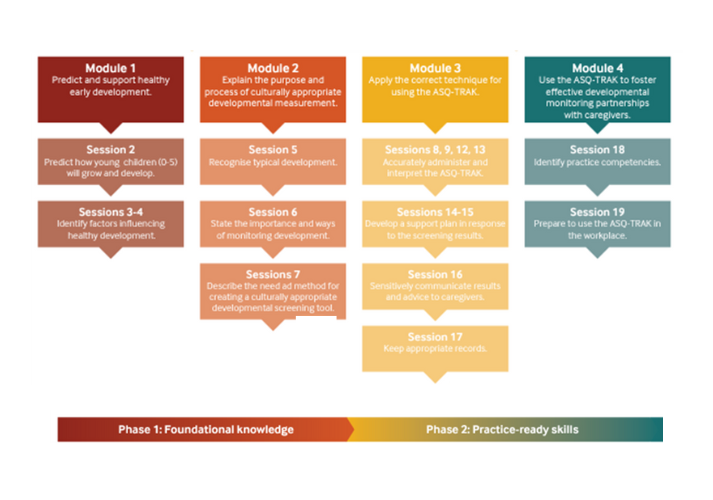
The workshop will cover modules 1 to 4 (see image below).
In addition to learning how to administer the ASQ-TRAK, the program has a focus on working with families in a culturally safe way. The workshop has been shown to improve practitioners' skills, knowledge, competence, and confidence to identify and manage developmental difficulties and promote child development (D'Aprano et al., 2015). Participants have also reported that it is an opportunity for team building, bringing together team members with different professional backgrounds, to ensure a shared understanding of the need for culturally responsive developmental monitoring and the best practice approaches.
We are transitioning to a co-facilitation model as best-practice for all training workshops. We are committed to a bi-cultural co-facilitation model, so Aboriginal and Torres Strait Islander facilitators will work with non-Aboriginal and Torres Strait Islander colleagues to ensure the cultural safety of workshop participants and of the families that practitioners will then go on to work with.
Aboriginal and Torres Strait Islander co-facilitators will contribute to providing a culturally safe learning environment and to creating a space for practitioners to reflect on how they can provide culturally safe care to the Aboriginal and Torres Strait Islander families they work with. They will lead elements of workshop delivery to ensure a strengths-based approach. This will provide an opportunity for ongoing reflection of our practice and of the program's content by working with an Aboriginal and Torres Strait Islander educational supervisor. By working together with Aboriginal and Torres Strait Islander colleagues, we will ensure the ongoing quality and cultural safety of the program.
Our aim is to have Aboriginal and Torres Strait Islander Facilitators at all ASQ-TRAK Workshops. To support this commitment to the cultural safety of the participants and of the children and families they will go on to serve, our team of Facilitators undergo cultural safety training annually and access supervision with an Aboriginal cultural safety expert. This reflective practice is enhanced by accessing regular professional development in relational facilitation through the Centre for Community Child Health at the Royal Children’s Hospital.
On the advice of our Aboriginal and Torres Strait Islander advisor, we strongly recommend that all non-Indigenous participants complete cultural safety training prior to taking part in ASQ-TRAK Practitioner Training.
Practitioners who complete all of the education program's requirements are recognised as Certified ASQ-TRAK Practitioners and can use the ASQ-TRAK tool in their workplace.
You can review the ‘Becoming a certified ASQ-TRAK Practitioner checklist’ in the Procedure Guide.
On successful completion of ASQ-TRAK Practitioner Training, you will be awarded a Certificate of ASQ-TRAK Practice. This means you will be able to:
The Certificate of ASQ-TRAK Practice is valid for one year. To ensure the ASQ-TRAK is administered at a high standard and to support the ASQ-TRAK Practitioner Community we encourage annual certification.
To meet requirements for annual certification, you will need to:
On payment of the annual certification fee, and demonstration of ASQ-TRAK activity, you will be issued with your Renewed Certificate of ASQ-TRAK Practice.
Maintaining annual certification will provide ongoing access to the following benefits:
4. Receive discounts to other ASQ-TRAK events
ASQ-TRAK Practitioner Education Program is structured and evidence-based that builds practitioners' ability to use the ASQ-TRAK developmental screening tool in a culturally sensitive way. The program remains a non-commercial endeavour. All revenue from training funds the cost of the program preparation, delivery, and ongoing quality improvement. To incorporate the changes, we no longer have capacity to offer training to new Facilitators.
The program offers two streams of workshops:
Our organisational workshops are available for teams with a minimum of 14 participants ready to take part in the program. The workshop is delivered in-person over two consecutive days by our accredited facilitators at a venue of your organisation's choice.
Please download and read our information guide which outlines:
You can also estimate workshop prices prior to registering interest.
Our centralised workshops are hosted by the STRONG kids, STRONG future team in selected major cities across Australia. Delivered in-person over two consecutive days by our accredited facilitators, these workshops are designed for 10–14 participants. Places can be booked by individual participants or by organisations with smaller teams who don't meet the minimum numbers required for an organisational workshop.
Please download and read our information guide which outlines:
At STRONG kids, STRONG future, we understand that circumstances may change, and cancellations may be necessary. To ensure a fair and transparent process, we have outlined the cancellation and refund policy for our ASQ-TRAK Practitioner Workshops in the guides below:
All notice periods mentioned in this policy refer to calendar days, including weekends and public holidays observed by The University of Melbourne.
If you need to cancel your workshop booking, you must provide STRONG kids, STRONG future team with written notice, which will take effect when our team receives it.
No. You can not make changes to the ASQ-TRAK without formal permission.
Please get in touch with the ASQ-TRAK team at ASQ-TRAK@unimelb.edu.au if you would like more information.